How to hire construction workers in Kigali, step by step
Most hiring trouble on a Kigali site is a sequencing problem, not a shortage. Here is the order that works: trades and headcount first, sourcing second, checks third.
Iyi nkuru iboneka mu Cyongereza.

Ask around Kigali and you'll hear the same sentence: we can't find masons. Sometimes that's true. Far more often the crew was hired in the wrong order.
The usual order goes like this. The slab is pouring on Monday, so on Friday someone makes calls. Candidates show up at the gate on Monday morning. The foreman picks faces. Rates are agreed verbally at the wall. Paperwork happens later, or never. By week three there's a plasterer who turns out to be a helper, two names on the payroll nobody on site can place, and an argument about whether the daily rate included the Saturday.
None of that is a labour shortage. It's a sequencing problem. Fix the order and most of the pain goes away.

Step 1: Decide the trades and headcount, week by week#
Before you call anyone, write the programme out as a labour schedule. Trade, number of people, the weeks they're needed, and the skill level you actually need.
"Ten masons" is not a brief. "Six masons who can lay blockwork to a string line, plus four helpers, weeks three to nine, then two masons held for snagging" is a brief. The second version tells you what to screen for, what to pay and when to release people. The first version guarantees you'll carry men you don't need in week seven.
While you're planning, check whether your trade is one of the tight ones. The Rwanda State of Skills Supply and Demand Report of November 2024, published through the national labour market information system, sets out where employers report demand outrunning supply, including construction occupations. If your trade sits there, add lead time. The National Institute of Statistics of Rwanda also publishes quarterly and annual Labour Force Survey data broken down by occupational group, including craft and related trades workers, which is worth a look before you plan a ramp up across a quarter.

Step 2: Know where candidates actually come from#
In practice, most Kigali crews are built from three places: men already known to the foreman, referrals from those men, and whoever is at the gate.
That has one real strength. A referral from a mason you trust is a genuine signal about work rate and attitude. It also has two weaknesses. It's slow to scale beyond a few names, and nothing in it is verified. The chain runs on reputation held in one person's head, which leaves when that person leaves.
The ILO's market systems analysis of Rwanda's construction sector maps how workers are recruited, paid and supervised, and documents how common verbal arrangements and layered subcontracting are. The Labour Force Survey annual report from NISR covers job search methods and informality across the wider labour market. Read together, they describe what you already see at your gate: a large pool of working people reached through informal channels, with terms that get defined late or not at all.
So widen the funnel deliberately. Keep a list of people who have worked your sites before, with trade and rate. Ask each foreman for named referrals a week before you need them, not the night before. And use a source where identity and trade are checked before anyone arrives, so the gate is the last filter rather than the only one.
Step 3: Check what matters before the first day#
The checks that save money later are boring and quick.
Identity, confirmed against a document, with a record you keep. Trade evidence, which for most site trades means a short practical test rather than a certificate: set four blocks, bend and fix a stirrup, cut and hang a door frame. Prior sites, with one name you can call. And basic safety competence for the work you're giving them, because Law 66/2018 regulating labour in Rwanda puts health and safety duties on the employer, not on the man holding the trowel.
Do these before the first morning. A test at 07:00 on day one, with a concrete truck booked, is not a test. It's a formality you'll wave through.
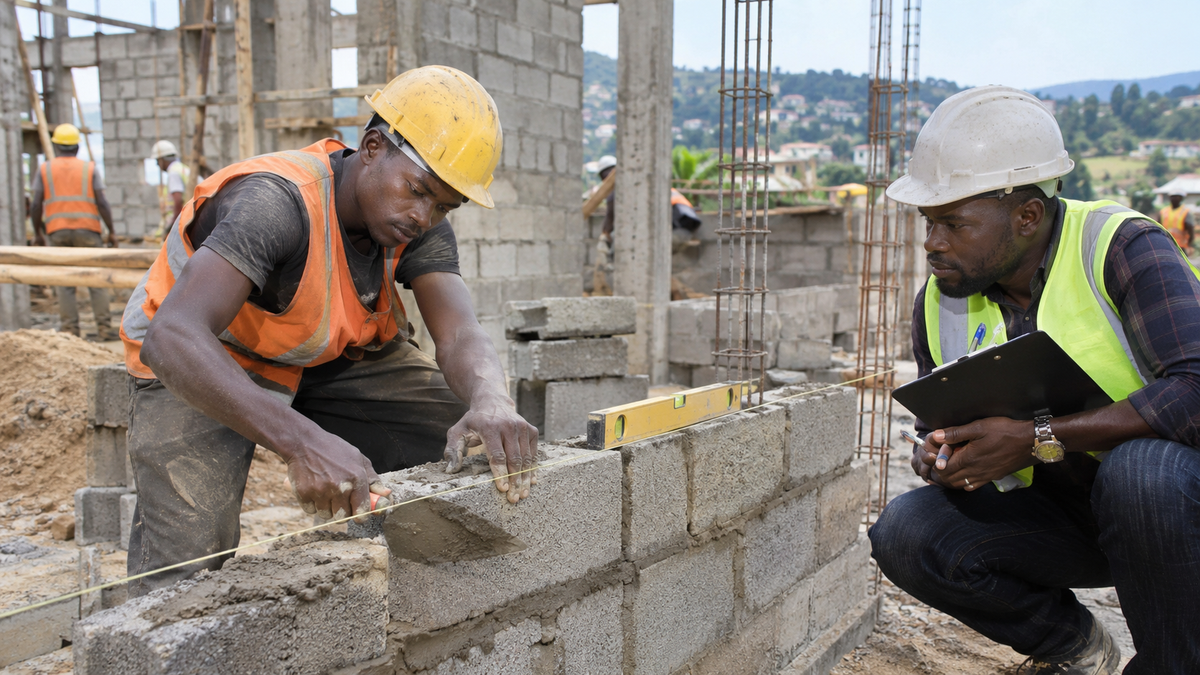
Step 4: Put the terms in writing before anyone picks up a tool#
This is the step most sites skip, and the one that causes the most disputes.
In Rwanda an employment contract can be oral or written, as WageIndicator's plain language explainer of Rwandan contract rules sets out. An oral deal with a carpenter is still a contract and still carries obligations. The only thing you lose by not writing it down is the evidence of what was agreed.
Law 66/2018 sets out the contract types available, including fixed term, open ended and occasional work contracts, along with probation, working hours, overtime, and notice on termination. The Ministerial Order of 19 March 2020 determining core elements of a written employment contract gives you the checklist: identification of the parties, job description, place of work, duration, wage and payment terms.
For site work, add the things that actually get argued about. What the daily rate covers and what it doesn't. Whether Saturday is normal time or overtime. Who supplies boots and a helmet. When pay lands, and in what form. Agree it in writing, in a language the worker reads, and give them a copy.
Step 5: Set up the pay plumbing before day one#
The rate you quote a mason is not what the worker costs you.
An employer guide to hiring in Rwanda from Playroll notes that salaries are paid in Rwandan francs, employees are registered with the Rwanda Social Security Board, and PAYE is filed monthly with the Rwanda Revenue Authority. The Enterprise Building Centre's business starter pack on human resources covers the duty to register the business and its employees with RSSB for pension and occupational hazards cover. A 2024 Rwandan payroll tax guide published by PaySpace sets out employee and employer contribution rates and the rule that contributions are remitted to RSSB by the fifteenth of the following month.
Work those numbers into your rate before you agree it, not after. And get registration done before the crew reports, because a backdated scramble in month two is where small firms lose days.
Step 6: Record attendance from the first morning#
A crew with no attendance record is a crew you cannot pay accurately or argue about honestly.
The ILO study on Rwanda's construction sector links irregular pay cycles and undefined terms to the grievances that surface on site. Most of those grievances come down to one question with no agreed answer: who was here, on which days, doing what. Decide how you'll answer that question before day one, and make sure the worker can see the same record you see. A disagreement about Tuesday is cheap on Wednesday and expensive on payday.

Where Buildpal fits#
Buildpal is built around this sequence. It connects contractors with verified, skilled workers, records their attendance, and pays them.
That means the identity and trade check happens before someone walks through your gate, the attendance record exists from the first morning rather than being reconstructed at month end, and payment runs off that record. The worker builds a work history they keep and take to the next job. You keep a record of who was on your site, which is the thing you need when a client, an inspector or a worker asks.
It does not remove your obligations as an employer. Law 66/2018, the written contract elements, RSSB and PAYE are still yours for now. What it removes is the part where all of that gets done in the wrong order, under time pressure, with no evidence.
The short version#
Write the labour schedule by trade and week. Source earlier than feels necessary. Check identity and skill before the first day. Put scope, rate, hours and payment timing in writing. Register and budget for RSSB and PAYE before the crew arrives. Record attendance from the first morning.
Do it in that order, and "we can't find masons" usually turns into "we started looking too late." That's a problem you can fix.
Sources#
- Law N° 66/2018 of 30/08/2018 regulating labour in Rwanda
- Ministerial Order determining Core Elements of a Written Employment Contract
- Employment Contract - Rwanda (WageIndicator)
- Business Starter Pack: Human Resources (Enterprise Building Centre Rwanda)
- Labour Force Survey Annual Report 2024, National Institute of Statistics of Rwanda

Product, field operations and engineering at Buildpal, writing about what we learn building a verified workforce for construction in Rwanda.


Ibitekerezo (0)
Nta gitekerezo kiratangwa. Tangiza ikiganiro.