How a construction worker in Rwanda finds the next job
Four routes get a construction worker to work: the morning gathering point, the foreman's network, a relative on another site. Here is what each one costs you in waiting and in certainty.
Iyi nkuru iboneka mu Cyongereza.
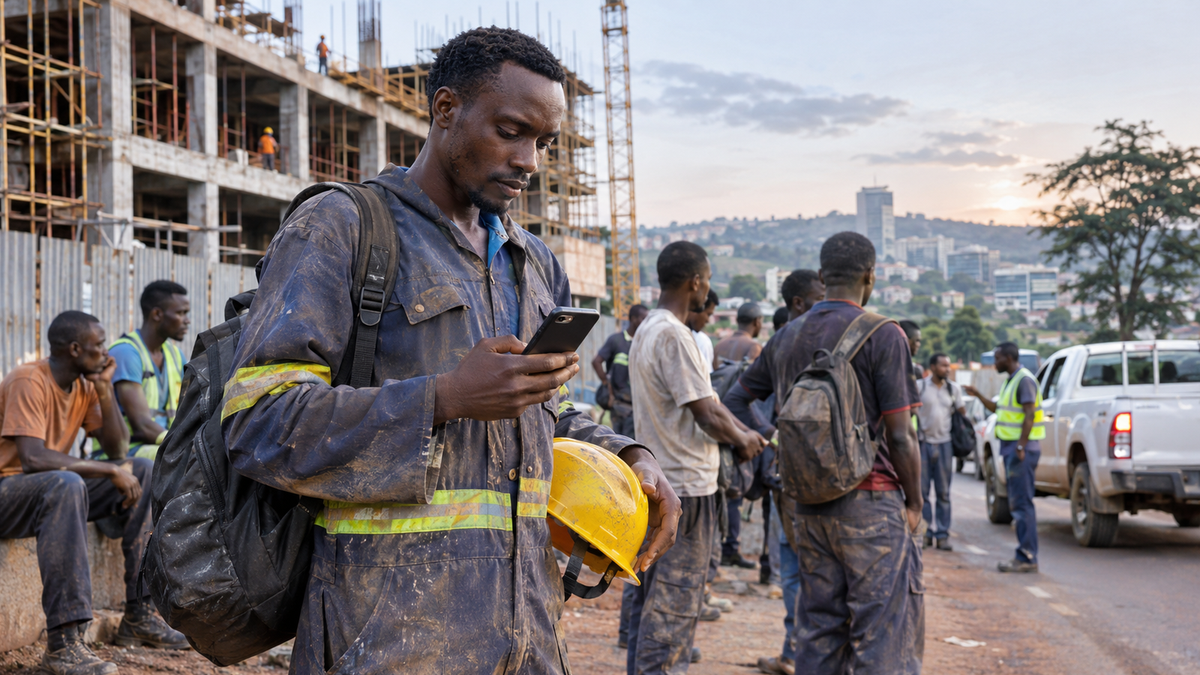
You finish a slab on Friday. By Monday, you need another job. Most construction workers in Rwanda use the same four routes to get called, and each one costs something different.
Construction is one of the main ways people here move from farming into paid work. The World Bank's Rwanda Employment and Jobs Study puts it at about 19 percent of non-farm wage employment. The work is there. What is often missing is a clear answer to two questions before you start: what exactly am I doing, and what exactly am I paid.
Route one: the morning gathering point#
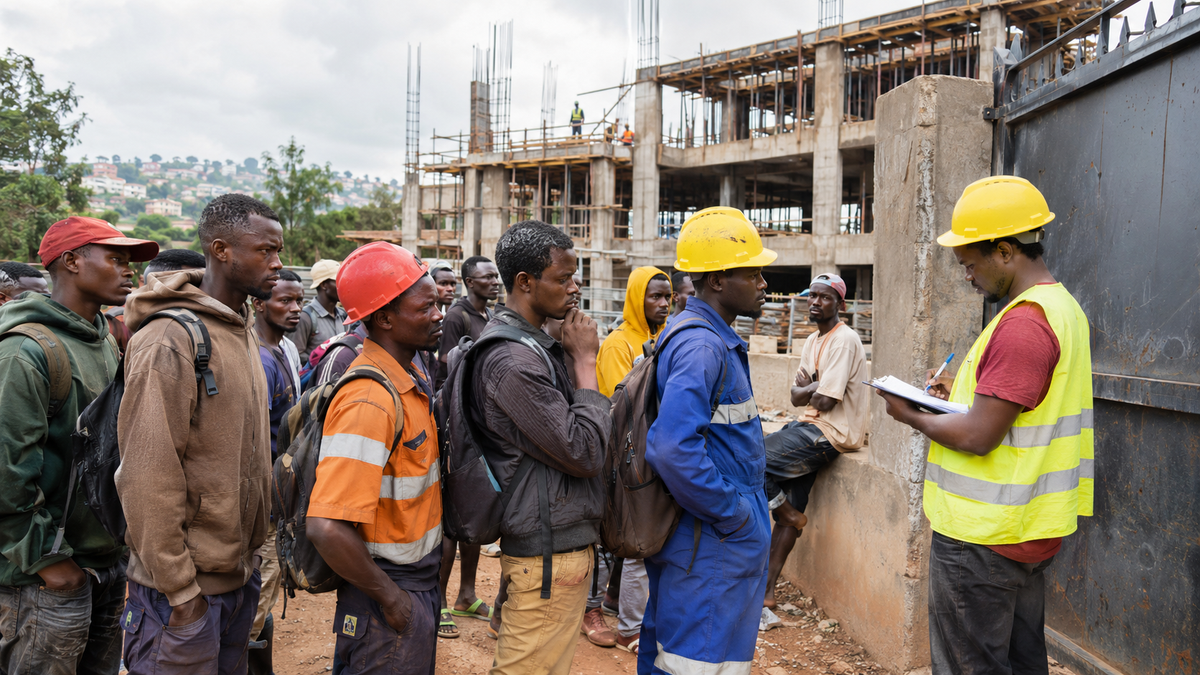
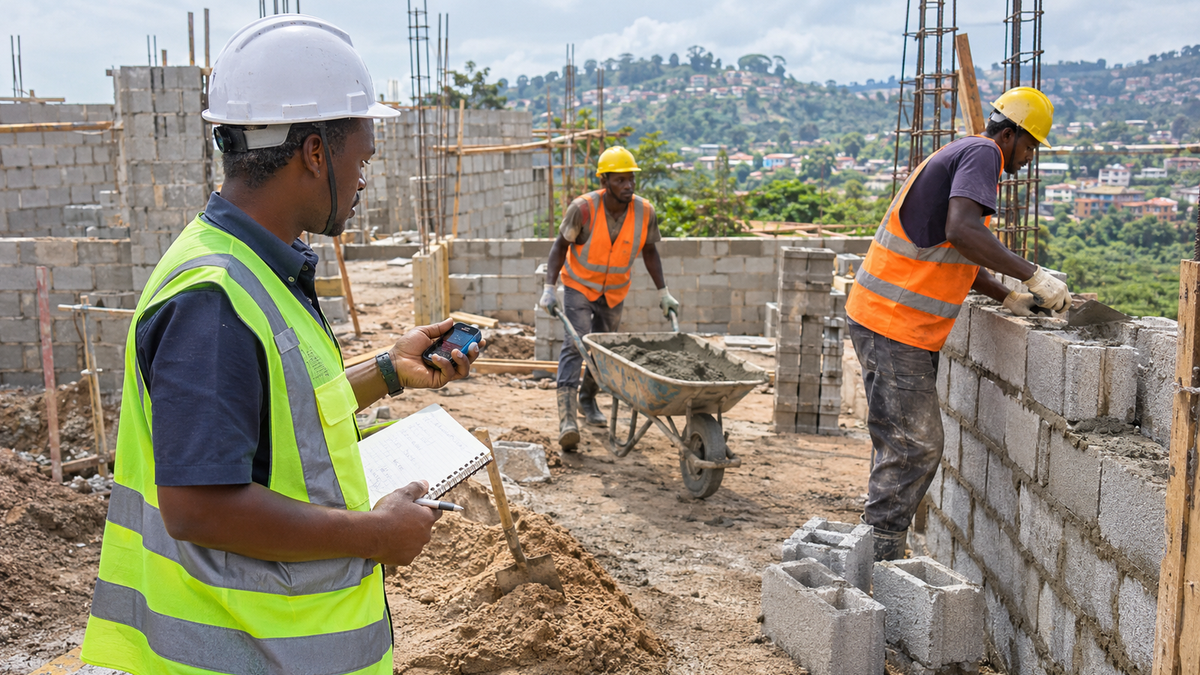
You stand at a known spot from early morning (locally known as "Indege"). A pickup arrives, or a foreman walks up, counts heads, and points. If you are picked, you work. If you are not, you go home having spent the fare and the morning.
This route is fast when it works. Nobody asks for your history, and nobody checks your skills, which is also the problem: you are paid as a pair of hands, not as a proven skilled mason or a bar bender. The rate is spoken, not written. Payment day is whatever the person who picked you says it is.
The cost here is waiting time with no floor under it. A bad week is three mornings standing and no day worked.
Route two: the foreman who has your number#
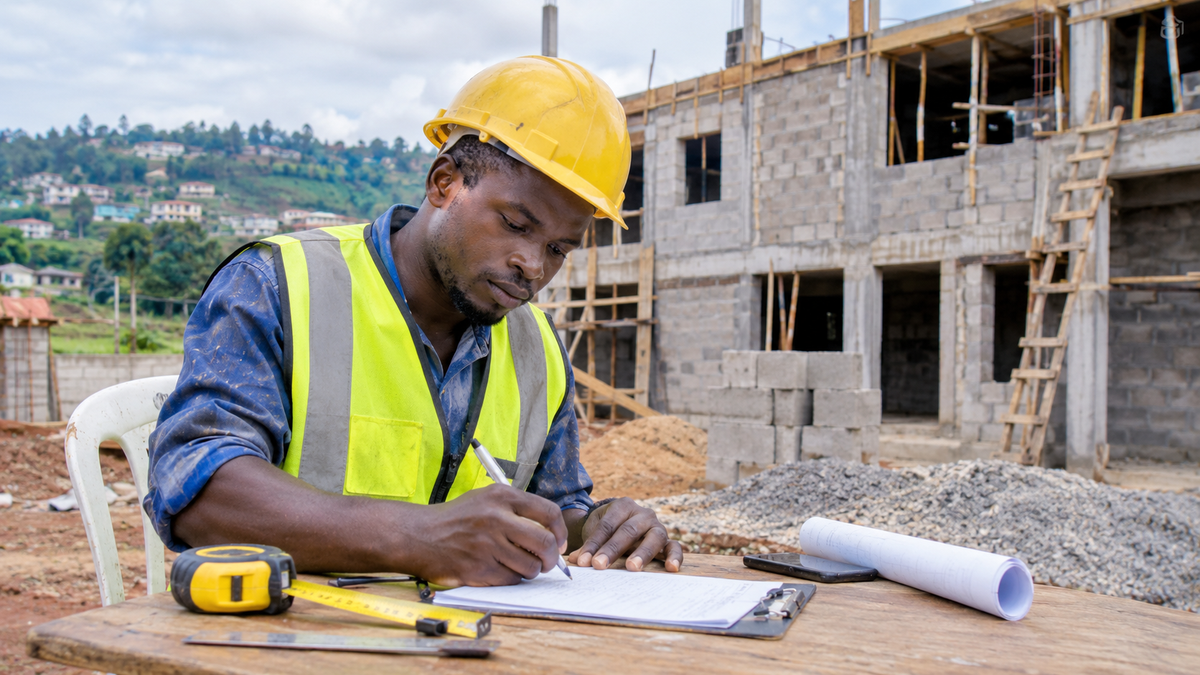
This is the strongest route most workers have. A foreman saw you work, kept your number, and calls when he has a gap.
Research on recruitment in Rwandan construction work packages describes this as the normal way sites are staffed, not an exception: employers lean on personal contacts, foremen and subcontracted labour gangs because it fills a crew by tomorrow morning. The ILO's market systems study of the sector found the same thing, along with what comes with it: verbal arrangements, long subcontracting chains and irregular pay cycles.
So a call from a foreman gets you work quickly. What it does not get you is terms. You learn the rate on the day. You learn the end date when the job ends. And if the money is short at the end of the week, the person who owes you is somewhere up a chain you cannot see.
There is also a quieter cost. You keep the relationship alive with favours, with being available, with not pushing on pay. That is real work, and it is unpaid.
Route three: the cousin on another site#
Word travels through family and former workmates. Your cousin is on a site in another district, the gang is short two people, and he tells you to come.
Rwanda's Labour Force Survey of February 2017 counted roughly 651,000 internal migrants, and listed building construction labourers and house builders among the largest occupation groups in the employed population. A lot of that movement is this route: people following word to where the work is.
It is a good route, because the person telling you has seen the site and knows whether the boss pays. The cost is that you usually travel before anything is agreed. You arrive, and then you negotiate, from a weak position, with your bag on your shoulder.
Route four: a booking that is written down before the day starts#
The fourth route is the one that looks slowest and is often the cheapest. Someone books you for named days at a named rate, and that booking exists somewhere other than in two people's memory.
Rwanda has a template for this already. Guidance from the Ministry of Local Government for works projects notes that, with no effective national minimum wage law, daily rates for skilled, semi-skilled and unskilled labour are set by common practice, and it sets out how those rates are to be fixed and recorded for public works using casual labour. The rate is still decided by the market. The difference is that it is written down before anyone picks up a trowel.
That matters because of where day rates actually sit. An employer payroll guide puts typical construction daily wages in Rwanda at about 8,000 to 15,000 RWF for trades labour, with no effective statutory minimum.
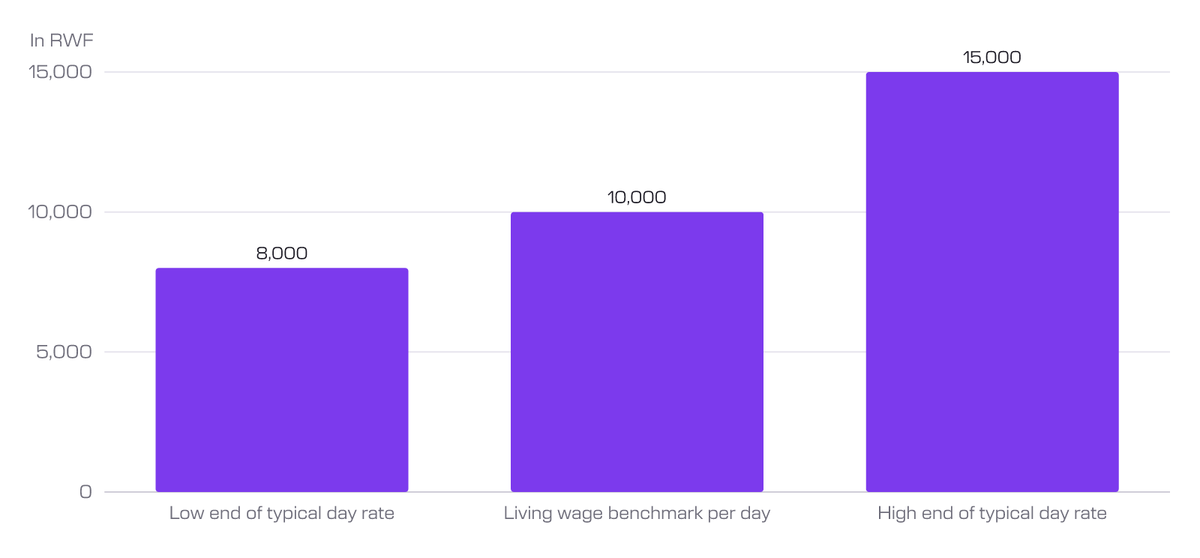
The gap between the bottom and the top of that range is nearly double. Which end you land on depends on whether your skill is recognised, and recognition is hard when every job starts from nothing and your record lives only in the heads of foremen who have moved on.

The four routes side by side#
| Route | Who calls you | What it costs you | What is written down |
|---|---|---|---|
| Morning gathering point | Whoever turns up short of hands | Fare and a morning, with no pay if nobody picks you | Nothing |
| Foreman with your number | One person or whole crew, when he has a gap | Staying available and not pushing on pay | Usually nothing |
| Relative on another site | Family and former workmates | Travel before the rate is agreed | Nothing |
| Recorded booking | The firm or contractor, ahead of the day | Time spent getting your details and skills on record once | Job, days, rate and attendance |
Why informal hiring is the default#
None of this is anyone's personal failing. The Danish Trade Union Development Agency's labour market profile recorded construction employing around 239,471 people with roughly 81 percent informality, and the ILO frames the sector as a fast-growing part of the economy built on a workforce that is 98 percent informal. The allAfrica report on Rwanda's changing labour market puts construction at about 9.8 percent of informal employment, behind market-oriented agriculture at 47 percent and trade at 16.7 percent.
The ILO's point is worth repeating for workers: better conditions come from changing how labour is contracted and paid, not only from more training. You can be the best block layer on the hill and still be paid late by a subcontractor you never met.
What to fix before you start#
Whatever route called you, settle these four things before the first hour of work, and keep a record of the answers on your phone:
- The scope. What am I doing, and for how many days?
- The rate. Per day or per unit, and in writing, even if it is only a message.
- The pay date. Which day of which week, and by what method.
- The name. Who is paying me, and which company they work for.
If the rate is not honoured, Rwanda does have machinery for it. The Danish Trade Union Development Agency profile describes mediation and arbitration and the role of workers' representatives in disputes. All of it works better when there is something written to point at. A verbal agreement between two people who now disagree is very hard to settle.
The part worth keeping#
None of these routes will disappear anytime soon. Foremen will still call workers they trust. Friends and relatives will still pass along opportunities. And workers will still go where they hear there is work. The problem isn't how the opportunity reaches you. It's how little of your experience follows you when the job ends.
A mason who has worked on ten sites should not have to prove himself from scratch at the eleventh. His skills, the days he worked, the sites he helped build, and the reputation he earned should count for something. But that can only happen when there is a record he can carry from one job to the next.
This is the gap Buildpal is working to close. By connecting construction workers with contractors who need their skills, recording bookings, attendance, and completed work, we're making it possible for a worker's experience to become something visible and useful beyond a single site. For contractors, it means a better way to find workers without relying entirely on who someone knows.
The next job may still come through a phone call or a recommendation. The difference is that your work history no longer has to live in someone else's memory.
Because every job you finish should count toward the next one.
Sources#

Product, field operations and engineering at Buildpal, writing about what we learn building a verified workforce for construction in Rwanda.

Ibitekerezo (0)
Nta gitekerezo kiratangwa. Tangiza ikiganiro.